Happy Juneteenth BWO community.
I want to talk about something that’s been sitting with me — and it connects directly to what this holiday is actually supposed to mean economically, not just symbolically.
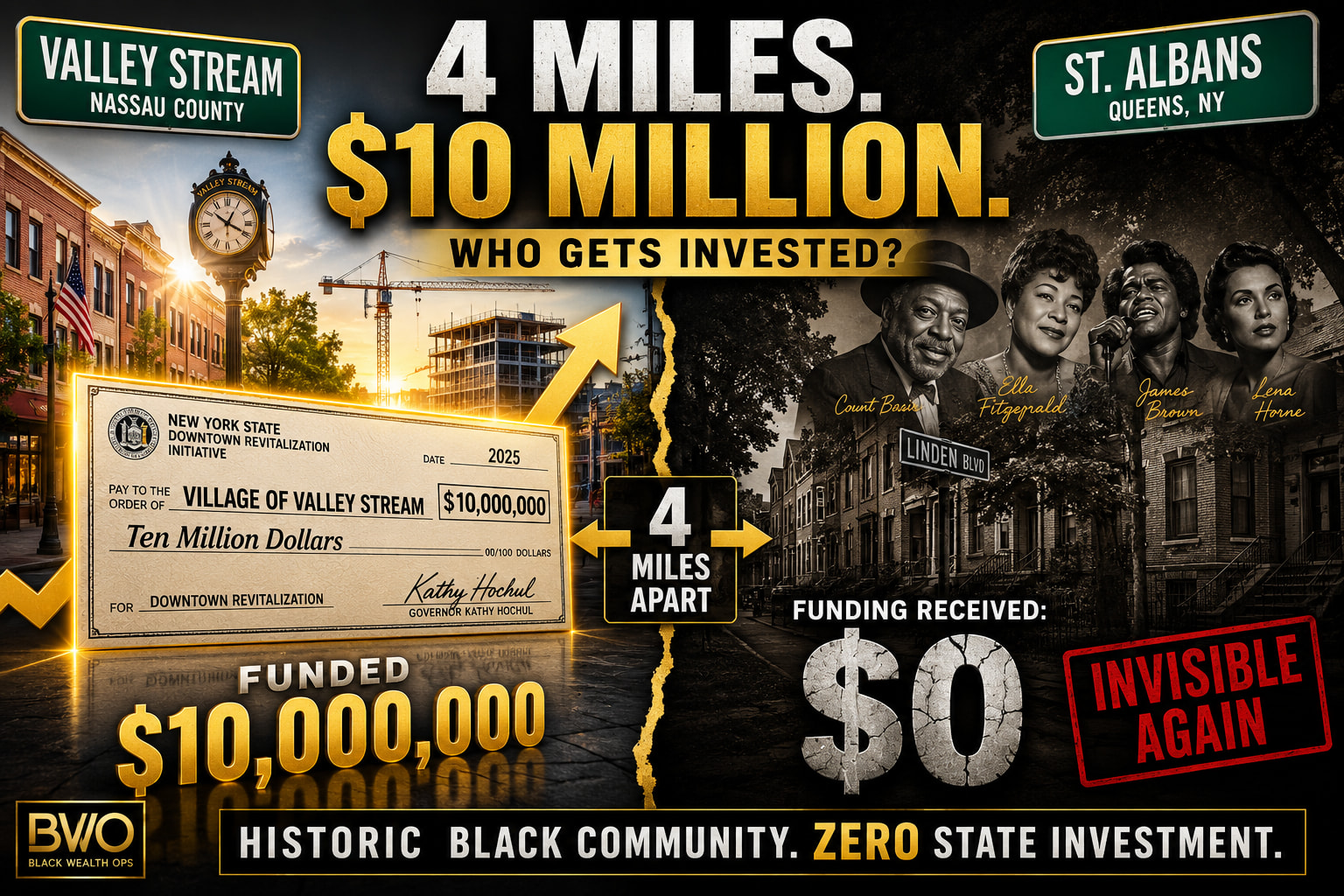
Governor Hochul just announced that Valley Stream — a village in Nassau County, Long Island — is receiving $10 million through New York State’s Downtown Revitalization Initiative. Round nine. One of ten regional winners across the state.
Good for Valley Stream.
Now let me tell you what’s been on my mind.
St. Albans, Queens — for those who don’t know — and frankly, too many people don’t — is one of the most historically significant Black middle-class communities in America. We’re talking about a neighborhood that housed Count Basie, Ella Fitzgerald, James Brown, Lena Horne, W.E.B. Du Bois, Fats Waller. This wasn’t just a Black neighborhood. This was a Black institution.
Valley Stream and St. Albans are approximately four miles apart.
Valley Stream got $10 million in targeted state revitalization funding.
Now before anyone responds — I know what’s coming. “But Southeast Queens is receiving billions in investment. The Jamaica Neighborhood Plan alone is paving the way for 12,000 housing units. CBS just did a whole piece on the Queens housing boom. What are you talking about?”
And that’s a fair point. Investment is flowing into Southeast Queens. Property values are rising. The Jamaica rezoning initiative is real and significant.
But that’s precisely the point I’m making — and I want to be precise here because this is a Narrative Capital argument, not a political grievance.
The question isn’t whether money is arriving in Southeast Queens.
The question is who controls its direction and who captures its benefits when it does.
Look at what’s actually happening across three different governance models operating within miles of each other right now:
Valley Stream — an incorporated village with its own mayor, its own government, its own economic development staff — applied for the DRI as a unified municipal entity and received $10 million in dedicated revitalization funding it controls entirely.
Jamaica — a city-designated growth hub with a comprehensive neighborhood plan, a recognized planning district, and a formal development framework — is receiving top-down investment directed by city planners and Albany priorities, not by Jamaica residents themselves.
St. Albans — despite rising property values, despite proximity to the Jamaica Neighborhood Plan’s entire rezoning footprint, despite being one of the most historically significant Black communities in America — lacks the independent municipal structure to compete for dedicated revitalization dollars and lacks the designated growth hub status to direct the investment that is arriving in its vicinity.
See the difference?
Valley Stream shapes its investment. Jamaica receives investment shaped by others. St. Albans watches investment flow through its borders toward adjacent areas without a single entity accountable for ensuring this specific community captures the benefits.
That’s not a complaint. That’s an institutional capacity analysis.
And here’s what makes it a Narrative Capital story rather than just a planning discussion — the architecture of how government investment gets distributed was built in a way that makes St. Albans functionally invisible to certain categories of funding.
Valley Stream is an incorporated village. St. Albans is a neighborhood — within Queens, within New York City, within layers of bureaucracy that have to be navigated before a single dollar of dedicated state revitalization money can even be considered. Community Board 12. The Queens Borough President’s office. The City Council. The State Assembly. The State Senate. Multiple layers of diffused political representation with no single entity accountable for delivering investment to this specific block of geography.
That bureaucratic reality isn’t accidental.
The communities that were denied incorporation, denied independent municipal status, and denied the political infrastructure to advocate for themselves in the post-war era — those are the same communities that now lack the governmental machinery to compete for revitalization dollars on their own terms.
Redlining didn’t just deny mortgages. It denied the institutional architecture that converts political geography into economic access.
Gentrification doesn’t solve that problem. It may actually accelerate it. Rising property values without community ownership of the development process means displacement dressed as progress. The neighborhood appreciates. The community that built it gets priced out before it can capture the appreciation.
That’s Narrative Capital operating at the government investment level.
The DRI program has now distributed $1 billion across 99 communities in nine rounds. I want to ask publicly — how many of those 99 communities are historically Black? How many are unincorporated urban neighborhoods rather than incorporated suburban villages with independent governing capacity? That research hasn’t been done publicly.
BWO is going to do it.
Because here’s the thing Juneteenth is supposed to remind us of.
Freedom without institutional access is incomplete freedom. The 13th Amendment ended slavery. It didn’t end the architecture that determined who got the mortgage, who got the incorporation, who got the municipal infrastructure, and who — generations later — gets to direct the $10 million revitalization grant versus simply watching it land nearby.
St. Albans deserves better than invisibility.
And the first step toward changing that is making the invisibility visible.
That’s what BWO is for.
Drop your thoughts below. And if you’re from St. Albans, Southeast Queens, or any community that’s watched investment flow past you into neighboring areas — I want to hear your story. Especially if you have data.
Building with you today.