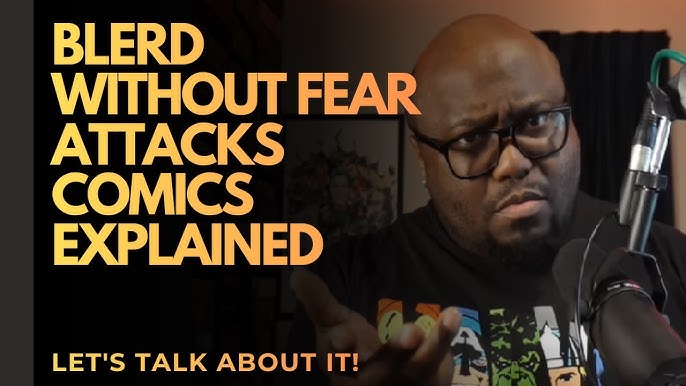
In recent weeks, a public exchange between Rob Jefferson of Comics Explained and Blerd Without Fear has drawn attention to a familiar question:
What responsibility—if any—do Black creators with large, mainstream audiences have to highlight Black intellectual property and creators within their content?
The discussion has largely been framed in cultural or personal terms.
But the more relevant question may be economic.
 Attention as Infrastructure
In the current media environment, large content platforms function as more than entertainment channels.
They are distribution systems.
Creators with significant reach do not simply produce content—they direct attention at scale. And in digital markets, attention is not abstract:
It is a precursor to demand, visibility, and ultimately, capital.
A channel with millions of subscribers operates, in effect, as a form of economic infrastructure—capable of influencing what audiences see, search for, and invest time and money into.
 Distribution and Value Capture
When that attention is consistently directed toward established intellectual property—whether from Marvel, DC, or other dominant entities—the economic outcome is predictable:
-
Existing brands consolidate visibility
-
Market share reinforces itself
-
Capital continues to flow toward already dominant IP holders
This is not inherently problematic. It is how markets behave under conditions of scale and repetition.
The question is what happens when alternative or underrepresented IP is not included within that distribution.
 The Cost of Omission
When Black creators or Black-owned intellectual property are absent from high-visibility platforms, the effects are cumulative:
-
Reduced discoverability
-
Lower audience familiarity
-
Limited demand signals
-
Constrained investment potential
Over time, this contributes to a structural pattern:
Cultural contribution without proportional economic capture.
This dynamic is not new. It has appeared across industries—from music and fashion to technology and media.
What is new is the degree to which individual creators now control distribution channels that were previously centralized.
 Integration vs Enclave
The question often posed is whether Black creators should establish separate spaces—“enclaves”—dedicated to Black content and audiences.
While such spaces can serve important cultural functions, they are not the only—or necessarily the most effective—economic strategy.
An alternative approach is strategic integration:
The deliberate inclusion of Black IP within mainstream-facing platforms that already command significant audience reach.
This approach does not require abandoning broader content focus. Instead, it introduces allocation:
-
A portion of attention directed toward emerging or underrepresented creators
-
Intentional visibility for Black-owned intellectual property
-
Consistent exposure that allows audience familiarity to develop over time
 From Attention to Ownership
The underlying issue is not simply representation. It is conversion.
Attention, when directed consistently, can lead to:
-
Increased consumption
-
Expanded audience bases
-
Greater monetization opportunities
-
Eventual ownership and equity growth
When that attention is not allocated, the pipeline weakens.
What is not seen is rarely scaled.
What is not scaled is rarely owned.
 A BWO Framework
From a BlackWallStreetOdds perspective, this dynamic can be understood as a form of capital allocation.
Large platforms—regardless of ownership—make implicit decisions about where attention flows. Those decisions have downstream economic consequences.
The question, then, is not one of obligation.
It is one of positioning.
-
How is attention being allocated?
-
What ecosystems are being reinforced?
-
Where is value being created—and where is it ultimately captured?
 Conclusion
In a market increasingly driven by platforms and visibility, distribution is no longer neutral.
It is directional.
Creators who achieve scale operate within that reality, whether explicitly acknowledged or not.
The opportunity—and the challenge—is to recognize that:
Highlighting underrepresented IP is not a cultural gesture.
It is a market action.
And in markets defined by attention, what is consistently omitted is often what remains undercapitalized.
If BWO seeks to understand how ownership is built, sustained, and expanded, then the role of attention—who directs it, and where—is not peripheral.
It is central.