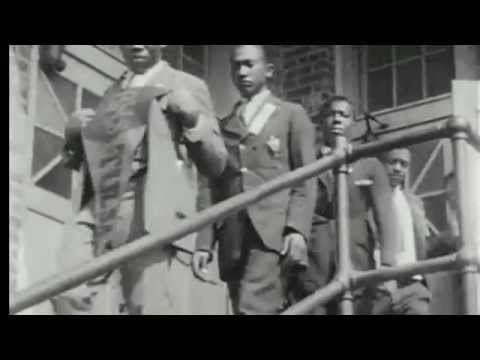
Most people discovered Greenwood through a television show.
In 2019 HBO’s Watchmen opened with a sequence that depicted the 1921 Tulsa Race Massacre with unflinching precision — the planes, the burning, the bodies. For many viewers it was the first time they’d encountered the event at all. The show wove it into an alternative history narrative that included a reparations program called “Redfordations” — a fictional government initiative named after a fictional president that addressed the massacre’s economic legacy directly.
The conversation that followed was significant. People who had never heard of Greenwood were suddenly asking why they hadn’t. People who had were asking why it took a prestige superhero narrative to make it visible.
That question deserves a serious answer.
But BWO’s interest is in a different question — one that the Watchmen conversation touched but didn’t fully examine.
Not “why didn’t we know?” but “what exactly was destroyed, what is it worth today, and why did the legal system just tell the last surviving witnesses they had no standing to collect?”
What Greenwood Actually Was
The “Black Wall Street” designation isn’t mythology. It’s economic description.
By 1921 the Greenwood District of Tulsa, Oklahoma contained over 600 Black-owned businesses operating in a 35-block area. The district had its own hospital, its own law firms, its own newspapers, its own hotels, its own theaters, its own schools. It had doctors, dentists, and lawyers who served a community that had been systematically excluded from white professional services.
The economic architecture of Greenwood was not accidental. It was the product of deliberate community investment — dollars that circulated within the district rather than flowing outward to white-owned businesses. By some estimates the Greenwood dollar circulated within the community up to 36 times before leaving. Today in most Black communities that number is estimated at six hours.
Greenwood was not just prosperous. It was structurally sound in ways that most Black communities have never been permitted to become.
On the night of May 31, 1921 and into June 1, a white mob — deputized by law enforcement, firing indiscriminately on Black Americans in the street, with planes dropping flaming turpentine-soaked rags and dynamite, and the bodies of Black victims thrown into the Arkansas River or into mass graves — destroyed it completely.
The mob torched and looted homes and businesses, including restaurants, hotels, theaters and a newspaper’s office. A truck mounted with a machine gun fired on Mount Zion Baptist Church before it was burned to the ground. No one was ever charged with a crime.
Contemporary reports of deaths began at 36, but historians now believe as many as 300 people may have died. Thousands were left homeless.
The economic loss in 1921 dollars has been estimated at between $1.5 million and $2 million — approximately $27 million to $35 million in today’s currency. But that figure captures only the immediate destruction. It does not capture what Greenwood would have become.
That is the number nobody wants to calculate.
The Compound Loss
A thriving Black economic district in 1921 — had it been permitted to continue its trajectory — would have become something significant by 2021.
The property values alone tell part of the story. Real estate in the Greenwood corridor that was destroyed in 1921 — had it remained in Black ownership, appreciated at market rates, been leveraged for subsequent investment and development — represents a compounded loss that dwarfs the immediate destruction.
The business infrastructure is the harder calculation. 600 Black-owned businesses in 1921, compounding over 100 years, reinvesting profits, expanding into adjacent markets, building the kind of institutional financial infrastructure that sustains community wealth across generations — that trajectory was not just interrupted. It was deliberately ended.
The human capital loss is perhaps the most significant and least discussed. The doctors, lawyers, teachers, and entrepreneurs who built Greenwood either fled Tulsa entirely or rebuilt under conditions of permanent economic disadvantage. Their professional networks dispersed. Their institutional knowledge scattered. The mentorship pipelines that would have connected them to the next generation of Black professionals were severed.
You cannot calculate what a community’s children would have built had their parents not been burned out. But you can acknowledge that the loss was real, that it compounded, and that it is measurable in the aggregate even when individual calculations are complex.
The Litigation — What Actually Happened
This is the part of the Greenwood story that most cultural discussions skip — and it’s the part BWO needs to examine carefully because it’s where the legal and financial argument becomes most precise and most instructive.
In 2020 a lawsuit was filed on behalf of the last three known survivors of the massacre — Lessie Benningfield Randle, Viola Fletcher, and Hughes Van Ellis, all over 100 years old — labeling the 1921 massacre as one of the worst acts of domestic terrorism in United States history since slavery.
The suit sought reparations for victims and descendants, including punitive damages, a compensation fund, a scholarship program for descendants of those living in the Greenwood district at the time, and mental health and education programs for Greenwood residents.
The plaintiffs argued that the city, county, and state created a public nuisance — or at minimum stood by while it happened — and then used the destruction to enrich their respective governments.
In 2022 the case appeared to be moving forward. The same judge who would later dismiss the case had ruled it could proceed, giving survivors and their attorneys genuine hope.
Then in July 2023 the case was dismissed.
The City of Tulsa argued in part that “simply being connected to a historical event does not provide a person with unlimited rights to seek compensation from any project in any way related to that historical event.”
The survivors appealed to the Oklahoma Supreme Court.
In June 2024 the Oklahoma Supreme Court upheld the dismissal, ruling that the plaintiffs’ grievances, although legitimate, did not fall within the scope of the state’s public nuisance statute. “We further hold that the plaintiff’s allegations do not sufficiently support a claim for unjust enrichment,” the court wrote.
Without comment, seven members of the court subsequently turned away a request to rehear the case.
Lessie Benningfield Randle — 109 years old at the time of the final dismissal — had witnessed the destruction as a child. She lived long enough to watch the legal system decline to hear her claim on its merits.
The Legal Analysis — Why the Dismissal Is Both Predictable and Revealing
BWO is not a legal platform and this is not legal advice. But the reasoning behind the dismissal deserves careful examination because it reveals exactly why the estate claim framework we’ve been developing in the Reparations Economics & Data category matters.
The lawsuit was structured around two legal theories — public nuisance and unjust enrichment. Both failed.
Public nuisance is a legal doctrine designed for ongoing harms — pollution, dangerous structures, continuing conditions that affect a community’s quality of life. Courts have been consistently reluctant to apply it to historical events, however catastrophic. The Oklahoma Supreme Court’s ruling was consistent with how most courts have treated this theory in reparations contexts.
Unjust enrichment requires demonstrating that the defendant received a specific benefit at the plaintiff’s specific expense. The court found the connection too attenuated — too many degrees of separation between the 1921 destruction and the current institutional defendants to satisfy the legal standard.
The individualized injury standard was the core problem — survivors failed to prove “individualized injury” sufficient to establish legal standing under the specific theories pleaded.
Here is what this reveals about the legal framework rather than the underlying facts.
The courts didn’t say the massacre didn’t happen. They didn’t say the destruction wasn’t real. They didn’t say the economic loss wasn’t calculable. They said the specific legal theories used to pursue the claim didn’t fit the specific facts of the case under Oklahoma law.
That is a legal strategy problem, not an evidentiary problem.
The underlying facts — documented destruction of specific properties owned by specific people whose descendants are identifiable — are not in dispute. The question is which legal framework most precisely captures the claim.
The BWO argument is that the estate claim framework — applying inheritance law logic to documented economic harm rather than public nuisance or unjust enrichment — may be the more precise instrument. Not because it’s guaranteed to succeed but because it applies a legal principle courts already accept universally and asks only that it be applied consistently.
The Watchmen Angle — Why Fiction Got There First
The HBO Watchmen series deserves credit for something specific beyond its cultural impact.
The “Redfordations” program in the show depicted reparations not as charity or apology but as a structural economic intervention — a government program with specific eligibility criteria, specific payment mechanisms, and specific economic goals. It treated the question as a policy and finance problem rather than a moral one.
That framing — fiction though it was — is closer to the correct analytical register than most actual policy discussions about Tulsa reparations have managed.
The show also depicted Greenwood’s destruction with specificity that the historical record supports — the planes, the deputized mob, the internment camps. For many viewers that specificity was the revelation. Not that it happened but that it happened with that degree of official involvement and organized violence.
The proto-Wakanda comparison that emerged from Black Panther’s success is worth examining briefly. Wakanda resonated partly because it depicted what Black civilization could look like without the interruptions of colonialism and extraction. Greenwood was not fiction. It was an actual demonstration of what Black economic self-determination produced when permitted to operate — and what happened to it when it became sufficiently successful to attract violent attention.
That parallel is not incidental. It is the historical argument in its most concentrated form.
The Reconstruction Question — Where Could It Actually Be Rebuilt?
You raise a genuinely interesting practical question — whether rebuilding Black Wall Street in a different area of Tulsa rather than the original Greenwood footprint is more viable than attempting to restore the original “GAP” (Greenwood, Archer, and Pine) corridor.
The honest answer requires acknowledging what has happened to the original Greenwood district since 1921.
The massacre destroyed it in 1921. The community rebuilt — remarkably, largely through its own resources, receiving essentially no government assistance — and by the 1940s Greenwood had recovered much of its commercial vitality.
Then urban renewal destroyed it again. Highway construction through the 1960s — specifically the I-244 highway built directly through the Greenwood District — demolished what the community had rebuilt after the massacre. The highway was not incidental. Urban renewal highway placement in Black communities was a documented national pattern, not a coincidence.
The current GAP corridor contains very little of the original Greenwood economic infrastructure. The physical and economic geography has been fundamentally altered twice — once by mob violence and once by government infrastructure decisions.
This makes the “rebuild in place” argument complicated. The original location carries historical and symbolic weight that matters. But the economic geography that made Greenwood viable in 1921 — its position relative to Tulsa’s commercial center, the density of the community it served, the walking-distance connectivity of its businesses — has been permanently disrupted by the highway.
A serious economic reconstruction conversation would need to address — where in Tulsa’s current economic geography could a Black commercial district achieve the same structural self-sufficiency that Greenwood achieved in 1921? That may or may not be the original footprint.
The City of Tulsa has acknowledged this question in its own language. The city stated it remains committed to working with residents on economic development and policy projects, the 1921 Graves Investigation, and a renewed community vision for the Kirkpatrick Heights and Greenwood Master Plan.
Whether that commitment translates to meaningful economic reconstruction — rather than commemoration and tourism infrastructure — is a different question with a different answer.
The BWO Bottom Line
Greenwood in 1921 was proof of concept.
It demonstrated that Black economic self-determination, when permitted to operate without systematic external interference, produces institutional infrastructure of genuine sophistication and durability.
It was destroyed — not by market forces, not by economic competition, not by any organic process — but by organized violence with government participation, followed by systematic legal and urban planning decisions that prevented reconstruction.
The survivors who lived to pursue legal accountability were told, at ages exceeding 100 years, that their claims didn’t fit the available legal theories.
That outcome is not the end of the argument. It is evidence for it.
Because what the litigation established — even in failing — is that the facts are not in dispute. The destruction happened. The economic loss was real. The compounded harm is calculable.
What remains is finding the precise legal and financial instrument that fits those undisputed facts.
That is the accounting project this category exists to advance.
The bill has always existed.
Greenwood is where it was first presented.
Discussion Questions:
What do you know about your own family’s connection to Greenwood or similar destroyed Black economic districts — Rosewood, Slocum, Elaine?
The public nuisance and unjust enrichment theories both failed in the Tulsa litigation. What legal framework do you think more precisely fits the documented facts?
The city’s Kirkpatrick Heights and Greenwood Master Plan is the current official response. Does economic development without specific reparative structure address the underlying claim?
If rebuilding Black Wall Street in a different Tulsa location were seriously proposed — what would the economic viability criteria need to be?