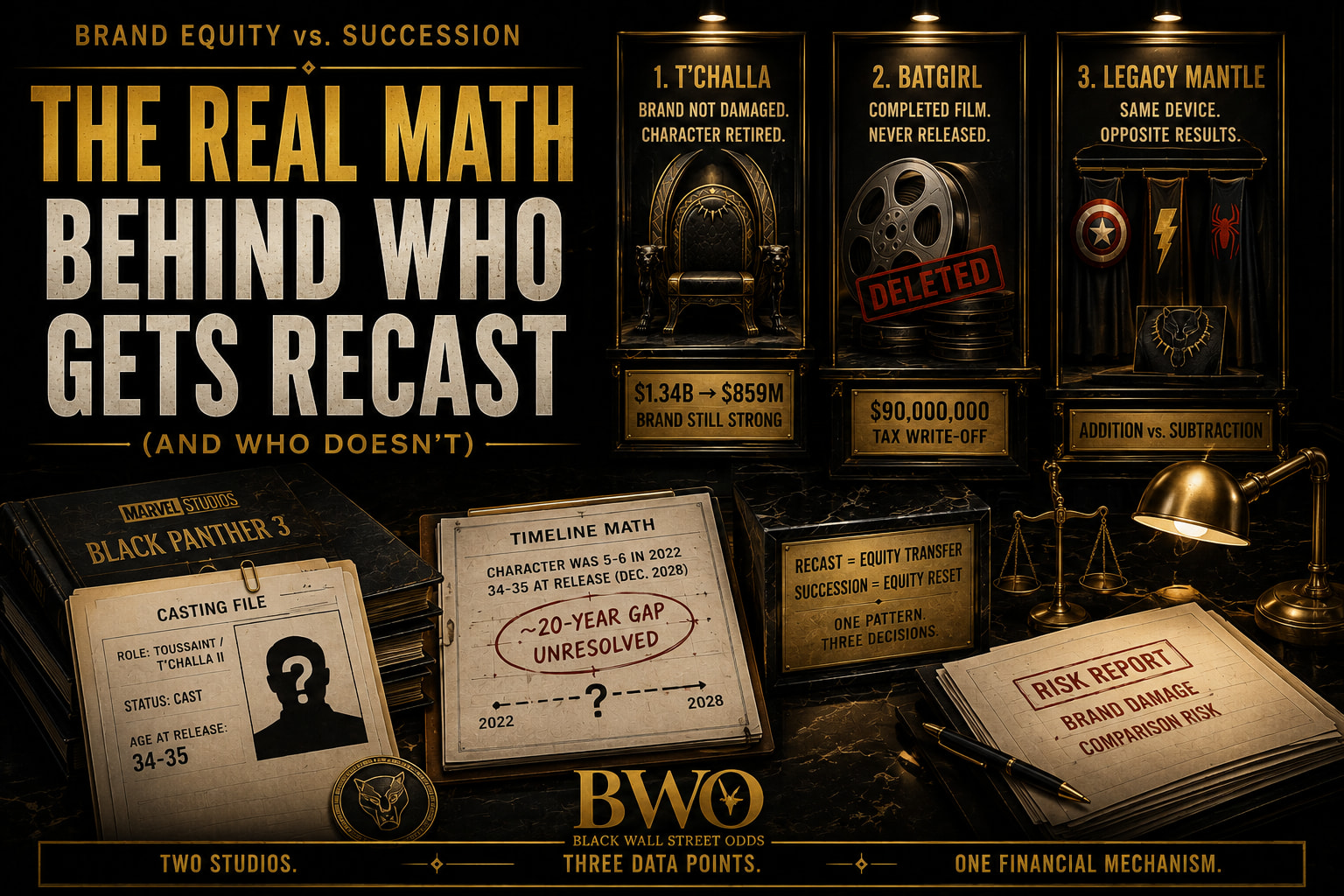
Companion resource to the BWO video “$90 Million to Delete Batgirl. Zero Dollars to Recast T’Challa.” Full sourcing and the framework below — drop your own examples and counter-examples in the replies.
The core framework, stated plainly
Two different studio decisions, two different outcomes, one underlying financial mechanism:
Recasting (new Bond, new Batman, new Superman) — brand equity carries over. Same name, same audience relationship, same box office expectation. The studio inherits decades of built-up trust with zero rebuild cost.
Succession/retirement (killing a character permanently and replacing them with someone new) — brand equity resets to zero. The audience has no pre-existing relationship with the new character. The studio has to build recognition, loyalty, and box office confidence from scratch.
That distinction alone explains a lot. What it doesn’t explain on its own is why one mechanism gets applied to some characters and not others.
The three data points
1. T’Challa. Black Panther (2018): $1.34B worldwide. Wakanda Forever, still handled with recasting for every other role: $859M. The brand was not damaged by Boseman’s death — audiences still showed up. Marvel retired the character anyway.
2. Batgirl. Warner Bros. Discovery had a completed film — not a script, not a pitch, an actual finished production with Leslie Grace in the suit. They shelved it entirely, took a $90M tax write-off, and never released it anywhere.
3. The legacy-mantle pattern, in reverse. Marvel uses “retire and replace with someone new” constantly — Sam Wilson becomes Captain America, Kamala Khan becomes Ms. Marvel, Miles Morales becomes Spider-Man. In every one of those cases, the mechanism adds a character of color into an existing, often white-coded legacy. Applied to T’Challa, the same mechanism doesn’t add anything — it subtracts an already-Black-led flagship and starts over.
The unresolved math problem
Marvel just cast an adult actor to play T’Challa’s son, Toussaint, for Black Panther 3 (December 2028). The character was 5-6 years old in Wakanda Forever (2022). The actor will be 34-35 at the film’s release. Closing that gap cleanly requires a story jump of roughly 20 years — but Shuri and M’Baku are confirmed returning, played by the same actors, who will have only aged 6 years in-universe by then.
As of this posting, Marvel hasn’t publicly explained how that timeline works. This is genuinely unresolved, not confirmed to be a plot hole — worth tracking as more details come out closer to release.
Why this matters beyond one franchise
The risk-avoidance read: recasting invites direct comparison (“worse than the original”), which is a real reputational risk a studio’s finance department has an incentive to avoid. Succession removes the comparison entirely — there’s no direct measuring stick if there’s no direct replacement. That’s a defensible business reason on its own. What’s worth discussing is whether that reasoning gets applied evenly, or whether it clusters around which characters get the “too risky to recast” treatment and which don’t.
Discussion prompt
Can you think of other examples — in film, TV, music, sports — where this same recast-vs-retire pattern shows up? Where has a franchise or brand chosen succession over recasting, and who benefited or lost from that specific choice? Drop your examples below — this is exactly the kind of pattern-recognition that makes for a strong “Part 2” if enough of you find good ones.