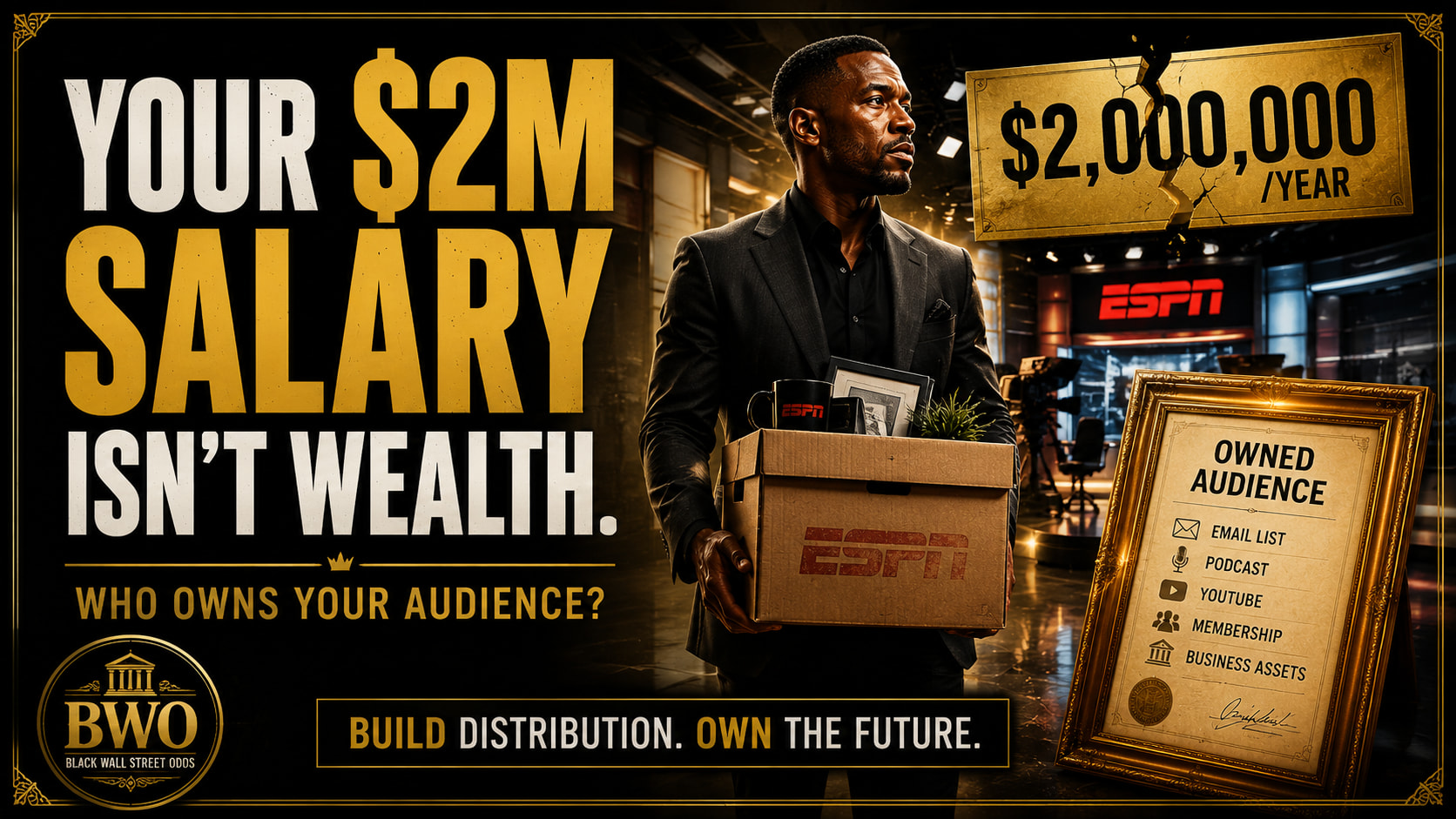
“Ryan Clark Made $2 Million a Year. ESPN Fired Him Live On Air Anyway.”
If you watched the video, you already know the core idea: a salary was never wealth. It’s rent. Ryan Clark didn’t lose his talent on July 20th — he lost access to a platform he never owned. This thread is the actual worksheet. Five steps, in order, with the specific numbers and actions behind each one.
Step 1: Build One Owned Channel First
Before anything else — before the LLC, before the diversification — you need at least one channel where you own the contact, not the algorithm.
-
The benchmark: 500 real email addresses you can message directly is worth more long-term than 50,000 followers a platform can bury, restrict, or delete tomorrow.
-
What counts as “owned”: an email list, a newsletter with exportable subscriber data, an SMS list. What doesn’t count: Instagram followers, YouTube subscribers, X followers — all borrowed, all revocable by a platform decision you don’t control.
-
Action this week: If you don’t have an email capture set up anywhere — link in bio, lead magnet, whatever — that’s step zero. Do that first.
Step 2: Open the Entity Before You Need It
Not after a severance conversation. Before.
-
The math from the video: at $2M/year, setting aside $250K annually for 5 years builds $1.25M in owned assets — separate from and outside of the employer relationship entirely.
-
Scale it to your income. The ratio matters more than the raw number. Somewhere around 10–15% of gross income routed into a separate entity, consistently, is a defensible starting target — adjust for your own overhead and runway needs.
-
What the entity is for: it’s not just tax structure. It’s the container that eventually holds your owned media, your IP, your equity stakes — the things Step 3 and Step 4 below actually produce.
-
Action: If you don’t have an LLC (or equivalent) yet, that’s the next concrete step, not a someday step.
Step 3: Convert Cultural Capital Into Financial Capital While You Have Leverage
This is the step people skip because it doesn’t feel urgent — right up until the leverage is gone.
-
The model from the video: Ice Cube didn’t just have a public persona. He used it to build actual equity in BIG3 — an asset with a balance sheet, not just a paycheck tied to appearances.
-
The distinction that matters: a show is income. Equity is an asset. Income stops the day someone else decides it stops. Equity doesn’t.
-
What this looks like practically: ownership stakes, IP you control, a company with your name on the cap table — not just your name on a marquee.
-
Action: Name one thing right now where you have visibility, reputation, or a following, but no equity attached to it. That’s your Step 3 target.
Step 4: Diversify the Platform, Not Just the Income
Most people think “diversify” means multiple income streams. That’s necessary but not sufficient — if all those streams run through one platform, you still have one point of failure.
-
The framework: a podcast, a newsletter, and a YouTube channel are three separate distribution systems, not three versions of the same one. If one gets demonetized, restricted, or shut down, the other two still reach your audience tomorrow morning.
-
The test: if your primary platform disappeared tonight, how would you tell your audience it happened? If the answer is “I couldn’t,” you don’t have diversification — you have one channel with extra steps.
-
Action: Identify your single point of failure. Then identify the second channel that doesn’t depend on it.
Step 5: Recognize That This Applies to You, Not Just TV Personalities
This is the step that applies whether you make $2M or $75K.
-
The reframe: if your income depends entirely on one employer’s decision, you have Ryan Clark’s exact structural problem — just with smaller numbers.
-
The example from the video: a corporate VP making $150,000 a year with no following, no side asset, and no owned distribution outside a company email signature is one leadership change away from the same overnight zero Clark experienced on camera.
-
The uncomfortable truth: Black media — and Black professionals generally — have gotten very good at negotiating salaries. Far less practiced at negotiating institutions. That gap is the actual subject of this whole framework.
-
Action: Rate yourself honestly on Steps 1–4 above. Wherever you’re at zero, that’s this month’s project — not someday’s.
The Bottom Line
Ryan Clark will be fine. He has the podcast, the reputation, the network relationships built over a decade. Most people don’t have that cushion when the call comes.
The five steps above are the difference between having Clark’s cushion and having Clark’s ceiling — the platform, the audience, the equity that’s yours regardless of who’s making decisions about your employment tomorrow.
Drop your Step 1 or Step 2 progress in the replies below. What’s your one owned channel? Do you have the entity set up yet? This thread works better as an accountability log than a static post — use it that way.
Discussed in the video: “Ryan Clark Made $2 Million a Year. ESPN Fired Him Live On Air Anyway.” — link in the pinned post above.