Black culture is arguably the most influential cultural export America has ever produced.
Music. Fashion. Language. Dance. Visual art. Athletic aesthetics. Internet culture. The global youth market didn’t just borrow from Black creative production — it was built on it.
That influence generates billions of dollars annually.
The question BWO wants to sit with seriously is: where does that money actually go?
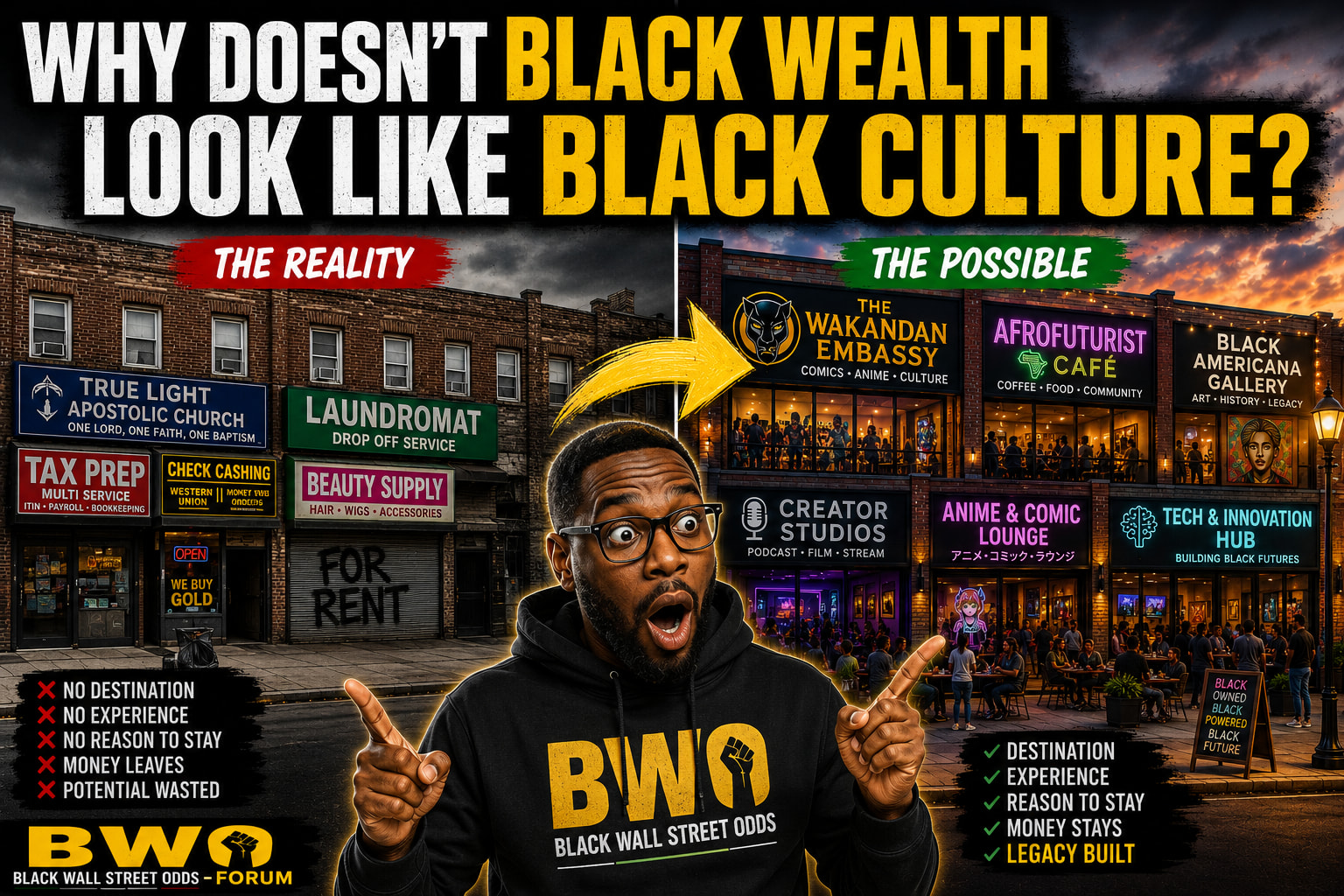
Because if you drive through most Black commercial corridors in America — not the exceptions, the typical ones — what you find doesn’t reflect the cultural output of the communities that created those corridors.
What you typically find is functional. Necessary. But not destination-oriented.
Tax prep. Check cashing. Beauty supply. Laundromat. Storefront church. Empty retail. Another storefront church.
These businesses serve existing residents. That’s legitimate and important.
But they don’t import wealth from outside the community. They recirculate what’s already there — or accelerate its exit to wherever experiences are available.
That’s the economic distinction worth examining precisely.
Destination Economics — The Actual Framework
Urban economists use the term destination business to describe commercial enterprises that attract visitors from outside the immediate neighborhood. Restaurants people drive to. Boutiques with regional reputations. Cultural venues that draw crowds. Experience-based retail that creates reasons to visit rather than just reasons to stop.
Destination businesses import wealth. They bring outside dollars into a community rather than simply processing the dollars already there.
Necessity businesses — laundromats, check cashing, tax prep — serve existing residents. They’re important. But they don’t grow the economic base. They service it.
The most commercially successful neighborhoods in any American city share a common characteristic: they have cultivated enough destination businesses that people make deliberate decisions to travel there. The spending that follows — food, retail, entertainment, incidental purchases — creates a commercial ecosystem that compounds over time.
This dynamic isn’t about aesthetics or quaintness. It’s about whether money flows into a community or out of it.
Most Black commercial corridors are optimized for necessity.
The cultural assets that could generate destination traffic exist — abundantly — but they rarely manifest as physical commercial infrastructure in the communities that produced them.
That gap is what this piece is about.
The Paradox
Here’s the specific contradiction worth naming precisely.
Black cultural production shapes global markets. Hip-hop is the dominant global music genre. Black athletic aesthetics define sportswear. Black vernacular drives internet culture. Anime and comic fandom in Black communities is deep, documented, and commercially significant. Black Americana — vintage periodicals, artifacts, collectibles — is an emerging alternative asset class we’ve analyzed extensively in this forum.
Each of these represents genuine commercial demand that exists in Black communities and extends well beyond them.
Yet the physical commercial infrastructure to serve that demand is rarely located in Black neighborhoods.
The anime convention happens downtown. The comic shop is in the predominantly white suburb. The vintage record store that sells the music Black artists created is in the gentrifying neighborhood where rents have tripled. The Afrofuturist art gallery exists online but rarely as a physical destination in a Black commercial corridor.
The demand exists. The cultural production exists. The consumer base exists — both within Black communities and among the broader audiences that consume Black culture globally.
The commercial infrastructure to capture that demand locally is largely absent.
Why This Matters Beyond Aesthetics
This isn’t a conversation about making neighborhoods look nicer.
It’s a conversation about who captures value from cultural production and where that value physically accumulates.
When someone drives to a predominantly white neighborhood to visit a comic shop stocked largely with Black superhero titles — Miles Morales, Black Panther, Static Shock, Icon — the commercial real estate owner in that neighborhood captures value from Black cultural production. The employees there capture wages. The surrounding restaurants capture the incidental spending of people who came for the comics.
None of that economic activity occurs in the community that produced the cultural enthusiasm driving the purchase.
This is the extraction pattern we’ve documented throughout this forum in music, in film, in intellectual property, in historical artifacts. It operates identically at the neighborhood commercial level.
The community produces the culture. The value gets captured elsewhere.
The Institutional Architecture Question
Before we get to what could be built, it’s worth being honest about why the current commercial landscape looks the way it does — because the answer isn’t imagination deficit.
Capital access is the primary barrier. Small business loans in Black communities are denied at higher rates than in comparable white communities even after controlling for creditworthiness. This is documented, not asserted. The Markup’s 2021 analysis of 2.7 million mortgage applications found persistent racial disparities that can’t be explained by financial variables. The same pattern holds in commercial lending.
Commercial real estate ownership patterns matter. When the buildings in a commercial corridor are owned by landlords outside the community, the rents extracted leave the neighborhood regardless of what business occupies the space. Destination businesses require lease terms and tenant improvement allowances that landlords are more willing to offer tenants they perceive as stable. Black entrepreneurs face documented discrimination in commercial leasing that constrains what gets built before capital is even the question.
Zoning and municipal investment patterns shape commercial viability. Parking, streetscaping, signage regulations, and basic infrastructure maintenance all affect whether a corridor reads as a destination or a necessity strip. These are government decisions that have historically favored some neighborhoods over others.
These structural barriers don’t excuse inaction. But any serious analysis has to acknowledge them rather than implying the absence of destination businesses reflects a failure of community imagination.
The Institutional Model Question — A Note on the Black Church
This piece isn’t a critique of Black faith. The Black church has been the most important institution in Black American life — the organizational infrastructure of the civil rights movement, the social safety net when government failed, the community anchor through every period of crisis.
But the institutional model is worth examining honestly in an economic context.
The synagogue model — to use a comparative frame — typically includes the religious institution plus an adjacent ecosystem: the community center, the day school, the business network, the investment cooperative, the cultural programming that draws non-members. The religious institution functions as a hub around which broader economic and civic infrastructure organizes.
Many Black religious institutions operate primarily as the religious institution alone — without the adjacent economic and civic infrastructure that converts community organizational capacity into community economic capacity.
This isn’t a theological critique. It’s an institutional design observation. The organizational capacity exists. The question is whether it’s being deployed to build the kind of adjacent infrastructure that compounds community economic power over time.
Some Black churches and religious institutions are doing exactly this — economic development arms, community development financial institutions, housing corporations. Those models deserve more attention and replication than they typically receive.
What Could Actually Be Built — Specifically
This section is deliberately specific rather than aspirational — because vague inspiration isn’t useful and BWO is in the business of serious analysis.
Blerd Cultural Hub — The Wakandan Embassy Model:
A physical space combining comics, graphic novels, manga, anime merchandise, Afrofuturist art, and Black collectibles at the retail level — with podcast studios, creator co-working space, and event programming upstairs. This business model works because blerd culture already has cross-demographic appeal. The customers aren’t exclusively from the immediate neighborhood. Asian anime enthusiasts, white comic collectors, Latino gamers, and parents of children who consume this content across every demographic would drive to a well-executed version of this concept. The cultural authenticity of a Black-owned blerd hub in a Black neighborhood adds rather than subtracts from the appeal.
Black Americana Gallery and Market:
We’ve analyzed this in this forum’s Cultural Asset Trusts category. Vintage Ebony and Jet magazines, civil rights memorabilia, historic Black photography, vintage soul and jazz records, Black comic book first editions — these are emerging alternative assets with serious collector markets. A physical gallery that functions simultaneously as a retail space, an appraisal service, and an educational institution about the value of Black cultural artifacts is a destination business with genuine cross-demographic appeal and a commercial model that supports the CAT framework we’ve been developing.
Afrofuturist Café and Cultural Space:
A food and beverage establishment with serious design investment, programming infrastructure, and a clear cultural identity is the most replicable destination business model across different neighborhood contexts. The specific Afrofuturist aesthetic — which already has global recognition through Black Panther’s cultural impact — provides a distinctive identity that generic café concepts lack. Programming matters as much as the coffee: regular events, speaker series, artist showcases, financial literacy workshops create reasons to return beyond the initial visit.
Creator Economy Infrastructure:
Podcast studios, video production facilities, music recording spaces, and streaming infrastructure — available for hourly rental to community creators — serve a demonstrated and growing demand while building the content production capacity that supports BWO’s own distribution strategy. This is the business model that justifies the “media operations upstairs” component of the blerd hub concept.
The Honest Constraint
All of these concepts require capital that Black entrepreneurs face documented barriers accessing. That’s the structural problem the inspiring vision has to reckon with honestly.
The Project Capital framework we’ve been developing in this forum — community investment vehicles, CDFI partnerships, modernized Susu mechanisms — is directly relevant here. Destination business development in Black commercial corridors requires the same patient, community-aligned capital infrastructure that the broader Project Capital concept addresses.
The imagination exists. The market demand exists. The cultural assets exist.
The capital infrastructure and commercial real estate access are where the structural intervention is required.
BWO’s argument is that understanding those structural barriers — precisely, documentably, without flinching — is the prerequisite to addressing them. The communities that have built destination commercial corridors didn’t do it through inspiration alone. They did it through organized capital, institutional networks, and deliberate commercial real estate strategy.
Those tools are not unavailable to Black communities. They are systematically harder to access.
Making them accessible is the work.
Discussion Questions:
The destination economics framework suggests communities that attract outside visitors import wealth while those serving only existing residents export it. What specific policy or investment interventions most directly address this dynamic in Black commercial corridors?
The blerd cultural hub concept has genuine cross-demographic appeal. What other specifically Black cultural assets have similar destination business potential that aren’t currently being commercially developed in Black neighborhoods?
Commercial real estate ownership versus tenancy is the critical distinction in whether neighborhood commercial activity builds community wealth or extracts it. What mechanisms exist for community land trusts, cooperative ownership, or CDFI-backed commercial real estate acquisition in Black neighborhoods?
The synagogue versus storefront church institutional model comparison — is it fair and is it actionable? What would it take for Black religious institutions to more systematically develop adjacent economic infrastructure?