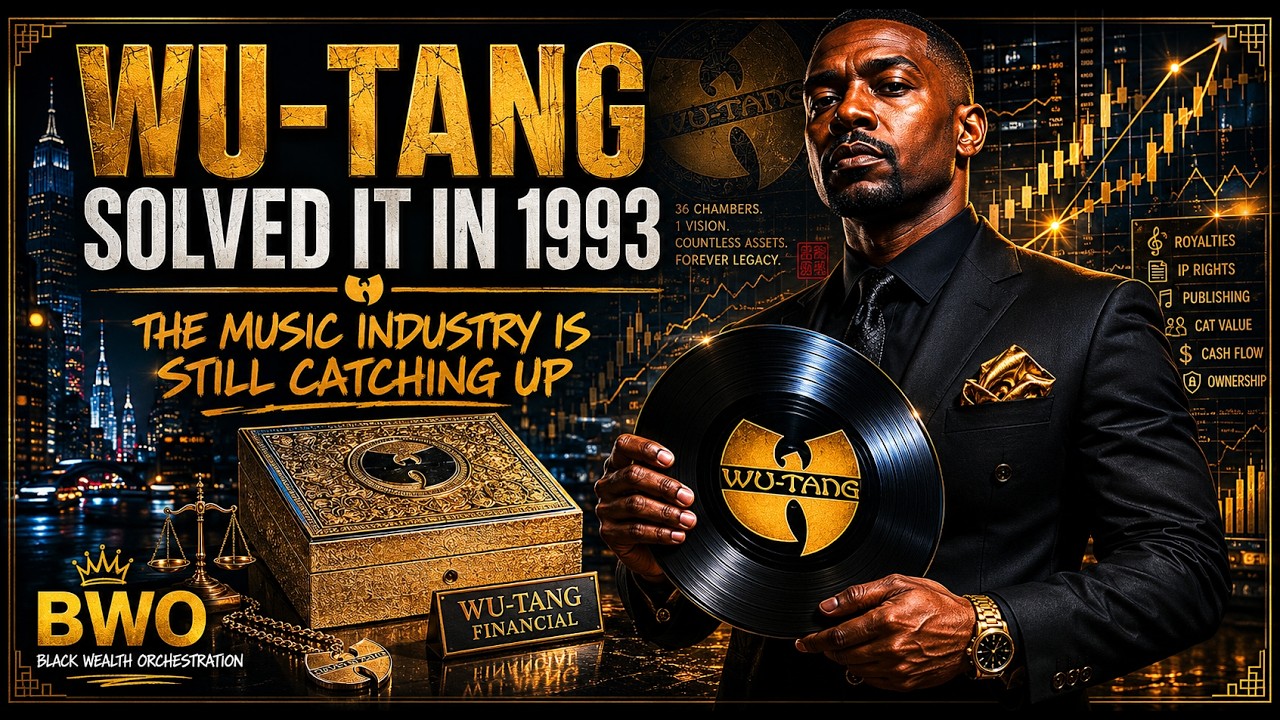
In 2003 Dave Chappelle aired a skit that made America laugh for four minutes.
Nine Wu-Tang members in full gear — swords, medallions, the whole aesthetic — delivering earnest financial advice to bewildered white clients. Diversify your bonds. Wu-Tang Financial.
The joke landed perfectly. The absurdity was self-evident.
But here’s the question BWO wants to sit with seriously:
Why was it absurd?
Not rhetorically. Actually. What specific element made the premise comic rather than plausible?
Because Queensbridge Ventures — Nas’s venture capital firm with investments in Coinbase, Robinhood, Dropbox, and Ring — is not a joke. Nobody laughs at Queensbridge Ventures. It gets written up in Forbes and covered in TechCrunch as a serious institutional operation.
Nas is from Queensbridge Houses. RZA is from Staten Island’s Park Hill projects. The biographical distance between those two origin points and the world of institutional finance is roughly identical.
So why does one read as legitimate and the other as punchline?
That question is the entire BWO thesis in miniature.
What Wu-Tang Actually Built
Before we examine why Wu-Tang Financial didn’t become real, it’s worth being precise about what Wu-Tang did build — because the mythology both overstates and understates the reality simultaneously.
The overstated part: Wu-Tang was not a perfectly functioning financial collective. Multiple members have publicly documented financial disputes with the group’s management structure. Ghostface Killah, Raekwon, and others have spoken candidly about feeling economically marginalized within the collective’s business arrangements. ODB’s estate disputes were extensively and sadly documented. The internal economics were considerably messier than the external mythology suggests.
Acknowledging this isn’t disrespectful to the legacy. It’s essential to understanding why the financial vision didn’t fully materialize — and what it would actually take to build something like it properly.
The understated part: What RZA did structurally in 1993 was genuinely sophisticated. Each member retained individual deal-making rights while the collective brand appreciated separately. Wu Wear preceded every major rapper-turned-fashion-mogul operation by years. The Once Upon a Time in Shaolin sale — one album, one physical copy, $2 million, eventually $4 million — anticipated artificial scarcity and asset singularity concepts that the broader market wouldn’t have language for until blockchain arrived a decade later.
The vision was sound. The infrastructure to execute it wasn’t fully there.
Why It Didn’t Become Real — The Honest Diagnosis
Wu-Tang Financial failed to materialize not because the concept was wrong but because four specific structural elements were missing.
Independent legal counsel for each member. When nine individuals with different financial situations, different risk tolerances, and different life circumstances operate under a single management structure without independent representation, conflict is not a possibility — it’s a mathematical certainty. Queensbridge Ventures works partly because Nas and Anthony Saleh have clearly delineated roles, independent counsel, and governance structures that don’t depend on personal loyalty surviving business pressure.
Transparent accounting infrastructure. Financial collectives fail most frequently not from bad intentions but from opaque bookkeeping. When members can’t independently verify what’s coming in and what’s going out, trust erodes regardless of the underlying economics.
Governance that survives interpersonal conflict. Wu-Tang’s structure was built on brotherhood. Brotherhood is a powerful foundation for creative collaboration. It is a fragile foundation for financial governance because it has no mechanism for resolving disputes that doesn’t threaten the relationship itself. Institutional governance — boards, operating agreements, defined dispute resolution — exists precisely to handle conflict without destroying the underlying enterprise.
Patient capital with long time horizons. The music industry operates on short cycles. Advances get spent. Tours end. Albums age. The financial model Wu-Tang needed required thinking in decades not album cycles — accumulating, compounding, reinvesting. That kind of patient capital discipline is genuinely difficult to maintain when members have immediate financial needs and no safety net.
Why Queensbridge Ventures Succeeded Where Wu-Tang Financial Didn’t
This comparison is instructive rather than critical.
Nas built Queensbridge Ventures with Anthony Saleh — a professional manager with institutional finance training — as a genuine operational partner. Not a hype man. Not a yes man. A counterpart with complementary skills.
The fund operates with standard venture capital governance. LP agreements. Defined investment theses. Portfolio management discipline. The cultural identity is authentic — Nas genuinely understood the platforms he invested in because he lived in the world they were disrupting — but the infrastructure underneath is professionally constructed.
That combination — authentic cultural intelligence plus institutional financial architecture — is exactly what Wu-Tang Financial would have needed and didn’t have.
The 2026 Blueprint
Here’s where the conversation stops being historical and starts being actionable.
The specific gaps that prevented Wu-Tang Financial from becoming real are all now addressable with tools and structures that exist today.
Legal infrastructure — entertainment and IP attorneys who specialize in collective ownership structures are more accessible than in 1993. Organizations like the Music Artists Coalition and Artist Rights Alliance exist specifically to support this.
Transparent accounting — blockchain-based royalty tracking makes financial transparency programmable rather than dependent on trust. Smart contracts can distribute revenue automatically according to pre-agreed splits without requiring anyone to trust anyone else’s accounting.
Governance structures — the LLC and operating agreement infrastructure that Queensbridge Ventures uses is accessible to any collective willing to invest in proper legal setup upfront.
Patient capital vehicles — platforms like Legion M demonstrate that fan-based collective ownership can generate the kind of long-horizon capital that sustains a creative enterprise across market cycles.
Financial literacy infrastructure — which is the piece you’re specifically identifying as missing and most needed.
The Hip-Hop Artist Financial Literacy Gap
The statistics here are genuinely striking and underreported.
The average career span of a commercially successful hip-hop artist is roughly 7 years. The average advance from a major label deal — which sounds large and is largely recoupable — leaves many artists in net deficit to their label for the majority of their active career. The standard 360 deal extracts revenue from touring, merchandise, endorsements, and publishing simultaneously.
An artist who understands what they’re signing is in a categorically different position than one who doesn’t.
Wu-Tang understood this better than almost anyone in their era. RZA’s refusal of standard deal structures, his insistence on creative sovereignty, his early experiments with brand extension — these were all expressions of financial literacy applied to the specific context of hip-hop.
The BWO argument is that this literacy should be infrastructure rather than individual genius.
Not every artist is RZA. But every artist deserves access to the knowledge RZA applied instinctively.
The Dave Chappelle Question Answered
Why was Wu-Tang Financial funny?
Because in 2003 the image of Black men from the projects as financial authorities was culturally coded as absurd. The humor came from incongruity — the gap between how Wu-Tang was culturally positioned and what financial authority was supposed to look like.
Twenty years later Queensbridge Ventures is in Forbes. Bitcoin was built significantly on Black adoption curves. The financial technology sector has been disrupted repeatedly by founders who looked nothing like the Wall Street archetype.
The incongruity has dissolved.
Which means the joke isn’t funny anymore.
Which means Wu-Tang Financial — properly structured, properly governed, properly capitalized — isn’t a punchline.
It’s a blueprint.
And blueprints are meant to be built from.